
American Whiskey Association Marks Bourbon Heritage Month Alongside Member Companies
“Made in America. Made for the World.” effort will amplify bourbon’s heritage, American agriculture...
Read more
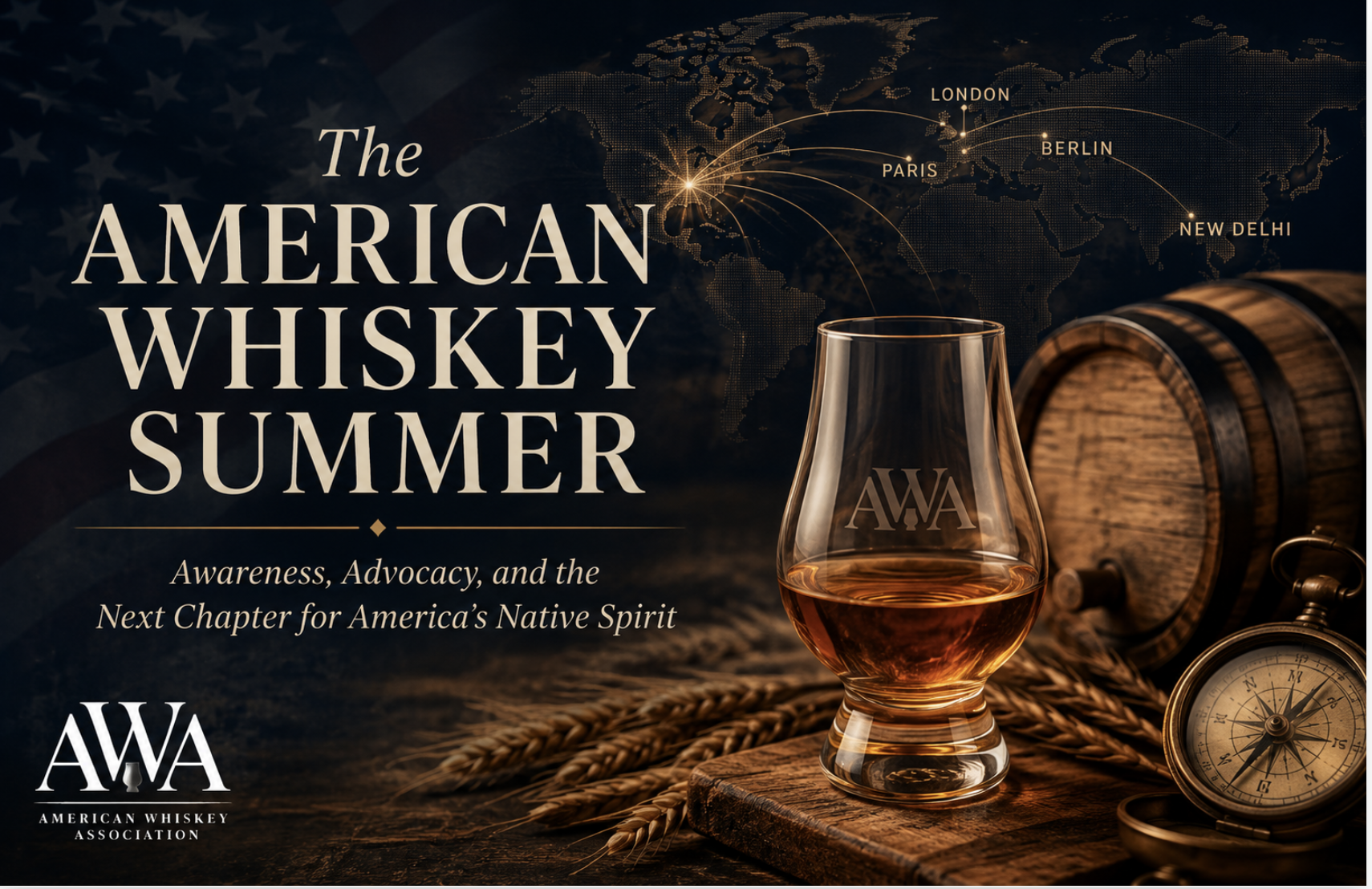
By Michael Bilello, President & CEO, American Whiskey Association
There are summers when an industry talks about opportunity, and there are summers when it goes out and creates it.
For the American Whiskey Association, the summer of 2026 has been the latter.
Over the past several months, our work has taken American whiskey from Washington to Brussels, Geneva, Paris, London, Berlin, New Delhi, and beyond. We have celebrated where this distinctly American product comes from, while simultaneously advocating for where it deserves to go next.
That combination, awareness and advocacy, has defined what I have come to think of as the American Whiskey Summer.
America’s 250th anniversary has provided an extraordinary platform to tell the American whiskey story.
Our America 250 activations helped put American whiskey front and center at diplomatic celebrations in Paris, London, Berlin, New Delhi, and other important markets. AWA bars, member-company activations, and partnerships with U.S. diplomatic posts brought our category into rooms filled with government officials, business leaders, international partners, media, and consumers.
But the real value went beyond the pour.
American whiskey tells an American story from grain to glass. It begins with farmers growing corn, rye, wheat, and barley. It depends on American oak, cooperages, distillers, warehouse teams, logistics providers, hospitality workers, retailers, and tourism communities.
And throughout this anniversary year, producers across the country are finding their own ways to connect whiskey to American history, regional identity, agriculture, craftsmanship, innovation, and culture.
America 250 is not one day on the calendar. It is an opportunity throughout this year to remind the world that American whiskey is both a heritage product and a modern American export.
Our job at AWA is to make sure the world understands both.
Promotion alone is not enough.
A consumer may want an American whiskey, but that demand means little if tariffs make the bottle uncompetitive, a provincial authority removes it from the shelf, a state tax regime prices it out of the market, or an inconsistent regulatory standard prevents it from reaching the consumer in the first place.
That is why awareness and advocacy have to move together.
India is perhaps the clearest example.
It is one of the world’s most important long-term opportunities for American whiskey, but reducing a national tariff is only the beginning. Meaningful market access requires workable implementation at the state level, predictable regulations, transparent taxation, consistent enforcement, and recognition of authentic product standards.
Recent regulatory activity in India has also highlighted an issue that should matter to every producer of authentic whiskey: category integrity. India maintains detailed alcoholic-beverage standards through FSSAI, underscoring the importance of clear rules governing how products are produced, labeled, and represented to consumers.
For American whiskey, authenticity is not advertising copy.
Our product is defined by standards, ingredients, process, maturation, and place. Authentic American whiskey derives its character and color through production and maturation, including the critical role played by new American oak for categories such as bourbon and rye.
Lowering trade barriers and protecting authenticity should not be competing objectives.
They reinforce one another.
There is no question that the current marketplace is difficult.
Consumers are more selective. Inventories are normalizing. Companies are managing costs carefully. Exporters have been forced to operate through extraordinary trade uncertainty.
But difficult is not the same thing as structurally broken.
Data reviewed by AWA and our member companies show that global whisky volume increased from approximately 469.8 million 9-liter cases in 2021 to 536 million in 2025, an increase of roughly 66.2 million cases, or 14.1 percent.
That matters.
The world is still drinking whisky.
American whiskey’s challenge is ensuring that our producers can compete for that demand.
Even after a difficult 2025, American whiskey remained by far the largest U.S. spirits export category, with approximately $1.08 billion in exports. DISCUS reports that the category’s export decline was heavily influenced by trade disruption in major markets, particularly the EU and Canada. Excluding Canada, overall U.S. spirits exports actually increased in 2025.
That is why I reject the idea that the current environment represents the death of American whiskey.
It represents a transition.
The next chapter will be defined by premiumization, innovation, tourism, disciplined inventory management, export growth, and access to more consumers around the world.
This summer also brought an important positive development in the transatlantic trade relationship.
The European Union extended the suspension of its proposed rebalancing measures against U.S. exports. That reduces an immediate threat to American producers and provides a more constructive environment for trade.
It is welcome progress.
It is also not something we should take for granted.
Trade conditions can change, and the transatlantic relationship will continue to require active engagement. Our goal should be durable, predictable, zero-for-zero trade in distilled spirits and a commercial environment in which American whiskey competes on quality rather than geopolitical circumstance.
Canada remains the stark counterexample.
Provincial restrictions have caused significant damage to U.S. spirits exports and demonstrate why removing a tariff is meaningless if the product still cannot get onto the shelf. DISCUS reported that exports to Canada fell dramatically after provinces removed American-made spirits from retail stores.
For American whiskey, market access means access.
Not simply a tariff rate on paper.
Another milestone this summer was AWA’s admission to the World Spirits Alliance.
That gives American whiskey a dedicated voice in global conversations involving trade, regulation, responsible consumption, evidence-based policymaking, and market access. WSA formally welcomed AWA during its 2026 General Assembly, expanding American whiskey’s representation within the international spirits community.
That matters because our category cannot afford to show up only after a problem develops.
We need to be in the room when international standards are discussed, when regulatory proposals emerge, when trade barriers are being considered, and when governments are deciding how spirits will be treated.
American whiskey belongs alongside Scotch whisky, Irish whiskey, tequila, cognac, and the other great geographically and culturally significant spirits of the world.
And it deserves a focused advocate protecting its interests.
This summer has also reinforced another important lesson.
Consumers are not simply choosing categories. They are choosing occasions.
That means American whiskey must remain relevant whether the occasion is a traditional neat pour, an Old Fashioned, a Manhattan, a Whiskey Sour, a highball, a premium ready-to-drink cocktail, a distillery visit, a restaurant experience, or a celebration halfway around the world.
Innovation works when it expands the occasion without abandoning the authenticity of the core brand.
It should not be traditional whiskey or innovation.
The strongest category can do both.
Heritage gets us into the conversation. Relevance keeps us there.
Our global competitiveness also depends on fixing disadvantages in U.S. policy.
That includes duty drawback.
American whiskey deserves inclusion and fair treatment within an export program that already benefits other U.S. manufacturers and beverage-alcohol producers.
This is not about creating a new government program.
It is about allowing an iconic American agricultural product with a long domestic supply chain to compete on a level playing field.
When American whiskey succeeds overseas, the benefit travels backward through that chain: to farmers, grain producers, cooperages, distillers, warehouse workers, logistics providers, hospitality businesses, tourism communities, and rural manufacturing economies.
That is why trade policy is not an abstract Washington debate for this industry.
It reaches all the way to the farm.
What makes me optimistic is not that the market is easy.
It is that the opportunity is increasingly clear.
Global whisky demand remains substantial. New markets are developing. Consumers continue to value authenticity, heritage, craftsmanship, and quality. American whiskey has all four.
What we need now is execution.
More markets.
More durable trade agreements.
More predictable regulation.
Greater protection for authenticity.
More opportunities for consumers to experience American whiskey.
And a stronger collective voice ensuring policymakers understand what is at stake.
The American Whiskey Summer has been about raising awareness of one of this country’s great native products while building the advocacy infrastructure necessary to take it farther.
We have spent this summer putting American whiskey in the room.
Now we intend to keep the door open.
American whiskey is America from grain to glass. Our mission is to LEAD it, PROTECT it, and PROMOTE it, at home and around the world.
Michael Bilello
President & CEO
American Whiskey Association
“Made in America. Made for the World.” effort will amplify bourbon’s heritage, American agriculture...
Read more
By Michael Bilello, President & CEO, American Whiskey Association Every September, Bourbon Heritage Month...
Read more