The American Whiskey Summer
Awareness, Advocacy, and the Next Chapter for America’s Native Spirit By Michael Bilello, President...
Read more
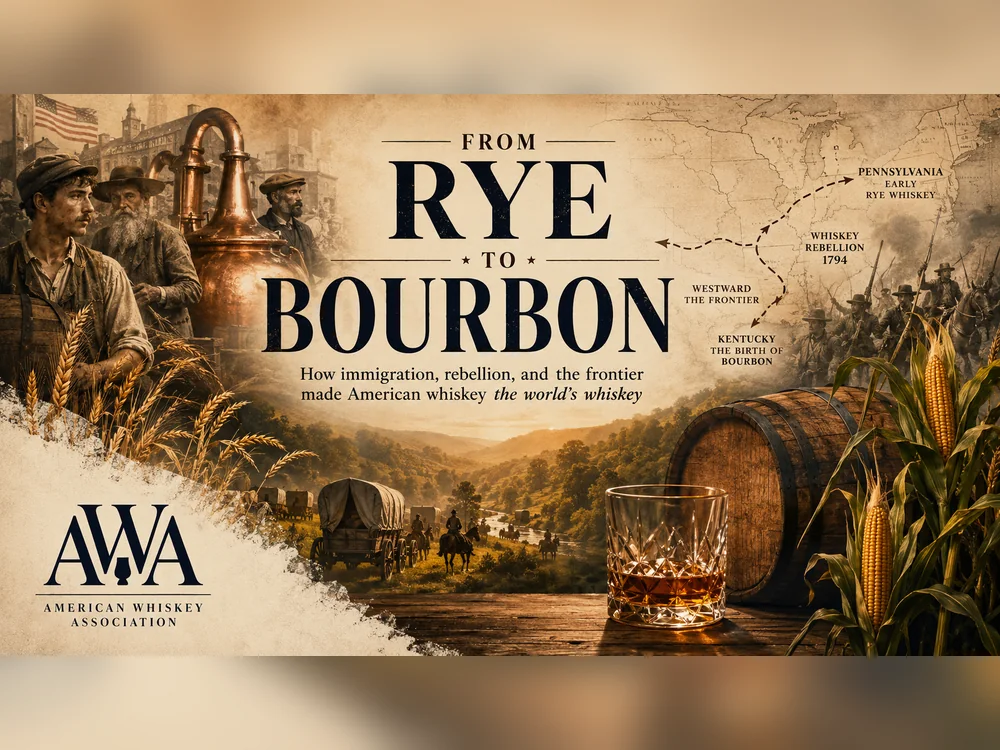
Long before bourbon became America’s postcard whiskey, American whiskey smelled like rye mash, wood smoke, and wet grain hauled over bad roads in Pennsylvania. That origin matters. If you want to understand American whiskey’s identity today—and its ambition to become, in the American Whiskey Association’s phrase, “the World’s Whiskey”—you have to start with migration. The people who settled colonial Pennsylvania did not arrive empty-handed. Germans came in large numbers to Pennsylvania, and early Irish and Scottish settlers also put down deep roots there. Along with language, religion, and farming habits, they carried grain culture and distilling knowledge from Europe and the British Atlantic world into the early republic.
Pennsylvania then did the rest. Rye was a practical grain for parts of the mid-Atlantic and frontier. More important, whiskey solved the frontier’s oldest logistical problem: grain is bulky, perishable, and miserable to move across mountains; whiskey is compact, durable, and saleable. The TTB’s own historical summary notes that western farmers distilled surplus grain because whiskey traveled better than crops and often served as currency in cash-poor communities. That was not colorful folklore. It was economic necessity. Early American rye whiskey was, in effect, agriculture made portable.
This is why the Whiskey Rebellion was always about more than drinking. In 1791, Congress enacted the new federal excise on distilled spirits. The law was supposed to help fund the young republic, but in practice it hit frontier producers where they were weakest: cash. The statute imposed graduated duties, and later commentary from the TTB notes that smaller distillers often paid a much higher effective rate per gallon than larger producers. Add the insult of distant federal courts—Philadelphia was roughly 300 miles from the Pittsburgh country—and resentment turned combustible. Hamilton wanted revenue. The frontier wanted arithmetic that reflected dirt roads and empty pockets.
By 1792, George Washington was issuing a proclamation against those obstructing “the laws of the United States for raising a revenue upon spirits distilled within the same.” By 1794, the conflict had escalated into the burning of tax collector John Neville’s house, the rise of rebel organization under men such as David Bradford, and Washington’s decision to federalize militia forces and march west. The episode became one of the earliest and clearest tests of whether the new constitutional government could actually enforce its laws. It could. But it also learned something in return: whiskey taxation in a frontier republic was politically radioactive. In 1802, Congress repealed the internal taxes, including the distilled-spirits excise.
So what does that rebellion have to do with bourbon? More than usually gets admitted. The Pennsylvania story established whiskey as a national commodity and a national political question. But as settlement moved west across the Appalachians, the grain equation changed. Kentucky and the Ohio Valley offered land, corn, and new transport pathways. Karl Raitz’s research on nineteenth-century Kentucky distilling shows the shift clearly: corn became a central starch source, and Kentucky distilling grew from farm craft into a larger industrial system shaped by water, later steam, labor, law, and improved transportation. By 1810, Kentucky already had more than 2,000 distilleries. The spirit of the frontier moved west—and swapped grain.
That is the real birth of bourbon: not a single miracle barrel, not one lone preacher-genius, and not one neat founding date. Kentucky’s own industry history admits that the origins of bourbon’s name are murky and that whiskey usually went by more generic place-based names before “bourbon” solidified commercially in the early nineteenth century. What made bourbon distinct, over time, was the alignment of corn abundance, maturing barrel practice, brand formation, and eventually federal standards and quality law. The short version is less romantic and more American: bourbon was built by adaptation, iteration, and scale.
Technology made the difference between a local habit and a national category. Early distillers worked with small copper pot stills and creek-side mills. During the nineteenth century, distilleries increasingly adopted steam power, larger works, and some column-still technology. Railroads and river transport let distillers operate at greater remove from the creek and closer to market logic. At the same time, maturation in charred oak became inseparable from bourbon’s identity. The Library of Congress has traced how scientific and technical writing in the nineteenth century made charring and oak maturation an intentional process rather than an accident, culminating in a 1907 Internal Revenue Service study that treated storage in new, charred oak barrels as virtually universal American practice.
Law then finished the job that geography and technology had started. The Bottled in Bond Act of 1897 imposed rules that tied spirits to a real distiller, real distilling season, bond supervision, and real proof disclosure. That did not merely protect consumers from fraud. It made whiskey legible at national scale. In 1964, Congress formally recognized bourbon whiskey as a “distinctive product of the United States,” explicitly placing it alongside imported categories already protected by marks of origin. In one long arc from the 1791 excise to the 1964 resolution, whiskey moved from frontier workaround to state-recognized national identity.
Yet if bourbon became the headline, rye never really stopped being foundational. George Washington’s own late-1790s distillery recipe—60% rye, 35% corn, 5% malted barley, distilled at least twice and sold unaged—captures the transition in miniature. Rye was still the backbone, but corn was already in the room. That is American whiskey’s deepest identity: not purity, but blend; not one migration, but many; not one grain, but the ongoing conversation among grains, regions, techniques, and markets. Anyone looking for a single “true” American whiskey is likely to end up arguing with a map.
That plural identity is now the category’s strength. DISCUS reports nearly 30 million 9-liter cases of American whiskey sold domestically in 2025, with more than $5.1 billion in revenue. The American Whiskey Association presents the category as a 50-state movement, not just a Kentucky franchise, and the premium end of the market has been one of the great success stories of the past two decades. IWSR likewise sees continuing prestige potential in bourbon, rye, and American single malt even through a softer market. In cultural terms, American whiskey is no longer a niche national spirit. It is a full family of spirits with domestic scale, tourism power, collector heat, and increasingly sophisticated global storytelling.
AWA and its Members will pour from the bottle and share their stories with the world — to become “the world’s whiskey.”
Awareness, Advocacy, and the Next Chapter for America’s Native Spirit By Michael Bilello, President...
Read more
AWA President and CEO Michael Bilello participates in high-level discussions on trade, market access,...
Read more