The American Whiskey Summer
Awareness, Advocacy, and the Next Chapter for America’s Native Spirit By Michael Bilello, President...
Read more

WASHINGTON, D.C. — March 31, 2026 — One year after Liberation Day, the American Whiskey Association (AWA) said today that the past year has reinforced a clear reality: American whiskey remains a globally relevant, premium-driven category with strong long-term potential, but its success depends on stable trade relationships, improved market access, and greater confidence in the international business environment.
Over the last year, American whiskey producers have faced a challenging landscape shaped by trade friction, retaliatory pressures, market uncertainty, and uneven conditions across key export markets. While the category’s long-term strengths remain intact, the experience since Liberation Day has made clear that American whiskey needs reliable access to customers abroad and a fair opportunity to compete in global markets.
For AWA, this one-year review is not about a single data point. It is about what the broader trend line has shown since Liberation Day: American whiskey continues to generate significant value, command premium positioning, and attract durable consumer interest around the world. But unnecessary trade barriers and instability continue to weigh on a category built for long-term growth.
“American whiskey is not in structural decline,” said Michael Bilello, President & CEO of the American Whiskey Association. “What we are seeing is a period of recalibration after years of strong expansion. The last year has made one thing very clear: market access, stability, and long-term confidence matter enormously to the future of America’s native spirit.”
AWA said the industry remains the leading U.S. spirits export category and continues to benefit from powerful long-term fundamentals, including premiumization, authenticity, brand strength, and global consumer appeal.
Recent market performance supports that view. From 2019 through 2022, U.S. American whiskey volume grew at a 4.6 percent compound annual growth rate, while value grew at an 8.6 percent compound annual growth rate. The category then moderated, with volume up 0.4 percent in 2023 and down 1.9 percent in 2024. Even so, value continued to rise, increasing 5.7 percent in 2023 and 0.9 percent in 2024 to reach $14.8 billion.
By 2024, the category remained well above its 2019 base in both volume and value, underscoring that the current environment is a normalization from an elevated base, not a collapse.
“The real story is not short-term noise,” Bilello said. “The real story is that American whiskey remains a premium-led category with strong value creation, deep consumer appeal, and real global growth potential. This industry is still on solid long-term footing, but no category can operate at full strength when trade conditions are unstable and market access is uncertain.”
AWA also emphasized that premiumization remains central to the category’s performance. In 2024, Premium-and-above accounted for 74 percent of total category value, including 44.9 percent from Premium and 29.2 percent from Super-Premium-and-above offerings. From 2019 through 2024, Premium-and-above grew at an 8.4 percent compound annual rate, while Super-Premium-and-above grew at 13.8 percent, far outpacing lower-priced segments.
That performance shows recent weakness is not universal across the category and that the higher end continues to demonstrate stronger long-term fundamentals.
“Value tells a more complete story than volume alone,” Bilello said. “Even with near-term softness in parts of the market, American whiskey continues to perform where it matters most: premium positioning, consumer loyalty, and long-term brand value.”
AWA said the industry’s current inventory discussion should also be viewed in context. American whiskey is an aged category with long production lead times, and supply decisions are made years in advance. Near-term softness and long-term demand planning can coexist, particularly in a category built around aging, premiumization, and future global expansion.
The long-term outlook remains encouraging. Global U.S. whiskey volume is projected to grow from 40.6 million 9-liter cases in 2024 to 45.8 million by 2034, with notable opportunities in markets such as Brazil, Japan, Germany, and Chile.
“Inventory should be judged with discipline and perspective,” Bilello said. “This is an aged category. You do not assess its future based on one soft patch or one headline cycle. The long-term trajectory should be measured by premium positioning, global demand, and the strength of the category over time.”
AWA also emphasized that the impact of trade disruption reaches far beyond distillers. American whiskey supports a broad domestic supply chain and economic ecosystem that includes farmers, foresters, cooperages, glass manufacturers, logistics providers, restaurants, bars, tourism, and rural communities across the United States.
“American whiskey is an American manufacturing, agricultural, and export success story,” Bilello said. “When trade barriers block access to important markets, the consequences do not stop at the distillery gate. They ripple across jobs, local economies, investment decisions, and communities that depend on this industry.”
One year after Liberation Day, AWA said the industry review points to the need for policymakers to remain focused on reducing tariffs, dismantling non-tariff barriers, and creating the conditions that allow American whiskey producers to compete on a level playing field around the world.
“If we want American whiskey to become the world’s whiskey, then fair and dependable access to global markets must remain a top priority,” Bilello said. “The opportunity is still there. The demand is still there. The question is whether policy will give American producers the chance to fully realize it.”
AWA also expressed appreciation for the continued engagement of the Office of the United States Trade Representative and said it remains hopeful that ongoing trade negotiations and market-opening efforts can deliver meaningful progress for the industry.
“We appreciate the continued engagement of USTR and the serious work being done in a difficult and fluid trade environment,” Bilello said. “We remain optimistic that policymakers can make real progress toward opening markets, reducing barriers, and giving American whiskey producers the certainty they need to plan, invest, and grow over the long term.”
About the American Whiskey Association
The American Whiskey Association is the global industry association for American whiskey with the mission of making American whiskey the world’s whiskey. Founded in 2025, AWA works to lead, protect, and promote American whiskey. Membership is open to distillers of all types and sizes, as well as industry partners and affiliated associations.
Awareness, Advocacy, and the Next Chapter for America’s Native Spirit By Michael Bilello, President...
Read more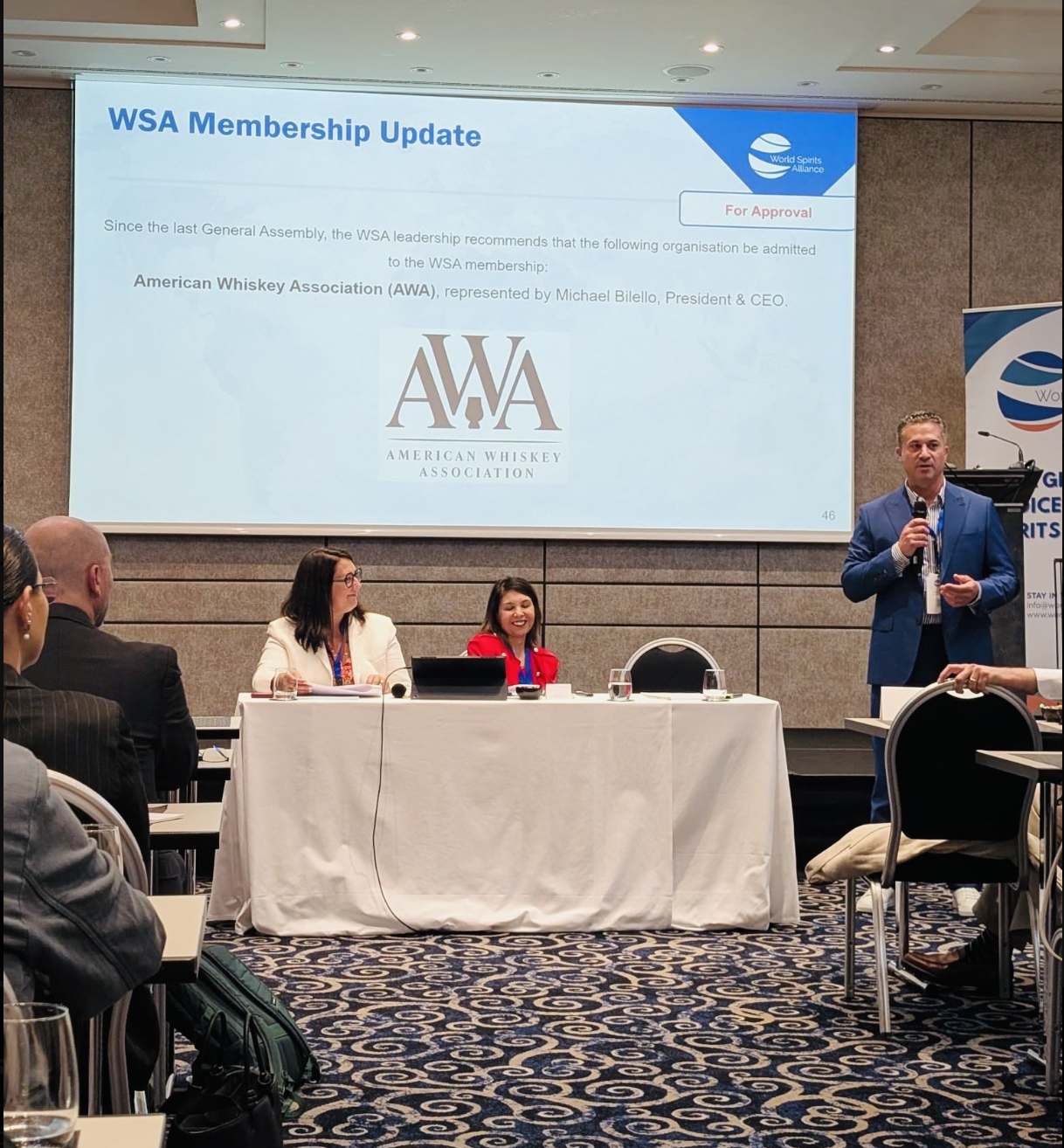
AWA President and CEO Michael Bilello participates in high-level discussions on trade, market access,...
Read more