
The American Whiskey Summer
Awareness, Advocacy, and the Next Chapter for America’s Native Spirit By Michael Bilello, President...
Read more

American whiskey is rooted in tradition — but the future of distilling is being built right now.
Across the country, American Whiskey Association member companies are leading by example, investing in advanced sustainability practices, circular production models, and next-generation infrastructure that position American whiskey as both an economic powerhouse and an environmental steward.
This is not performative sustainability.
It is operational excellence.
AWA member distilleries are designing and retrofitting facilities to meet LEED and high-efficiency standards — integrating:
Solar arrays and renewable energy sourcing
Smart HVAC and heat recovery systems
Low-impact building materials
Energy-efficient lighting and automation systems
Modern distillery campuses are increasingly built with sustainability engineered into the blueprint — not added later as an afterthought.
American whiskey is proving that heritage manufacturing can coexist with cutting-edge environmental design.
One of the most exciting areas of innovation among AWA members is the transformation of spent mash and stillage into compressed natural gas (CNG) and other renewable energy sources.
What was once a byproduct is now being:
Converted into renewable biogas
Repurposed for agricultural feed
Used in soil enrichment and composting
Integrated into circular fuel systems for fleet vehicles
Distilleries are increasingly viewing waste streams as energy streams.
That’s not just sustainability — that’s systems thinking.
Water is foundational to American whiskey. Responsible management of that resource is a priority across our membership.
AWA member companies are implementing:
Closed-loop water recycling systems
On-site water treatment facilities
Stormwater capture and reuse
Aquifer protection initiatives
The goal is simple: protect the natural resources that make great whiskey possible in the first place.
The future of distillery operations is circular.
From grain sourcing to barrel lifecycle management, AWA member companies are embracing models that reduce waste and maximize value:
Local grain partnerships to reduce transport emissions
Responsible forestry and white oak stewardship
Barrel reuse and secondary maturation programs
Supply chain optimization through data and digital infrastructure
Sustainability is no longer siloed — it is integrated across the full production ecosystem.
Global demand for premium American whiskey continues to grow. International consumers increasingly expect environmental responsibility alongside craftsmanship.
AWA members understand this.
Sustainability is not a marketing slogan — it is a competitive differentiator.
From LEED-certified facilities to CNG fuel systems, from water stewardship to circular grain programs, American whiskey producers are demonstrating that economic growth and environmental responsibility can move in tandem.
American whiskey is America’s native spirit. It is also one of America’s great manufacturing success stories.
The next chapter of that story will be defined not only by quality and export growth — but by leadership in sustainability, innovation, and operational excellence.
The future of distillery operations is already here.
And AWA member companies are building it.
Awareness, Advocacy, and the Next Chapter for America’s Native Spirit By Michael Bilello, President...
Read more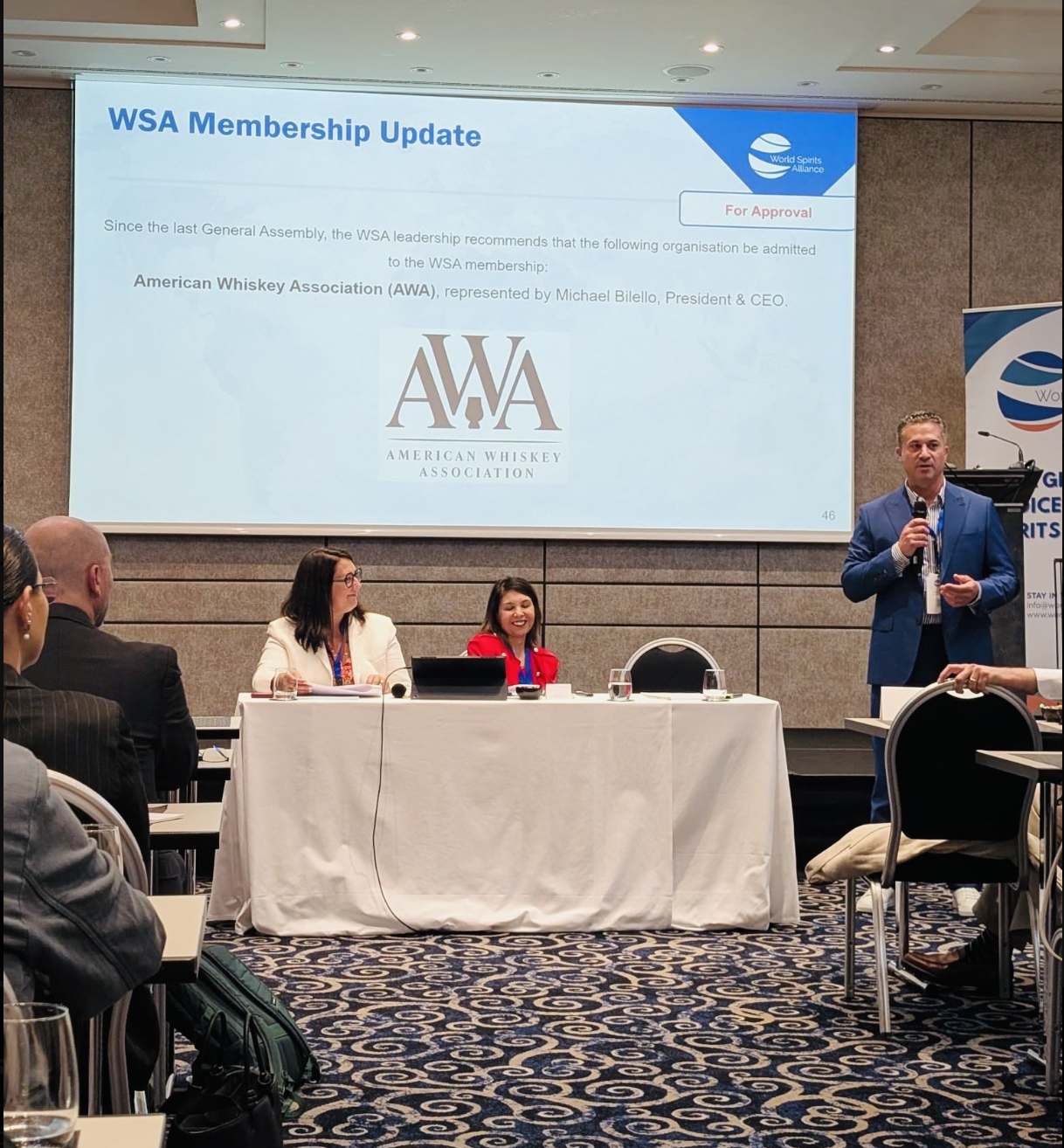
AWA President and CEO Michael Bilello participates in high-level discussions on trade, market access,...
Read more